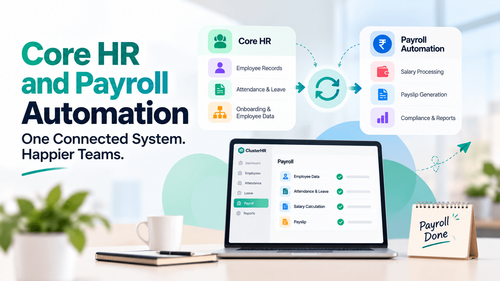
Managing employee information and processing salaries are two essential responsibilities for every business. Yet, many organisations still handle these activities through separate spreadsheets, disconnected software, and manual processes. Employee details are maintained in one place, attendance records in another, and payroll calculations in a separate system.
At first, this approach may seem manageable. But as a business grows, even a small data mismatch can create unnecessary work for HR teams, delay salary processing, and affect employee trust.
This is where Core HR and payroll automation work together to simplify employee management and salary processing. By connecting employee information with payroll workflows, businesses can reduce repetitive tasks, improve data consistency, and build more efficient HR operations.
Let's understand how these systems work, why integration matters, and what businesses should consider when choosing the right solution.
What Is Core HR Software?
Core HR software is a system that helps businesses manage essential employee information from a central platform.
It typically maintains records such as employee names, contact details, joining dates, designations, departments, reporting managers, employment status, and relevant documents.
Instead of maintaining multiple spreadsheets or searching through physical files, HR teams can access employee information through a centralised system.
For example, when an employee receives a promotion, the HR team needs to update their designation and other relevant employment details. A centralised HR system makes it easier to maintain these records consistently.
Core HR software can also support related processes such as employee self-service, onboarding, leave management, attendance tracking, and workforce reporting, depending on the platform.
Its primary purpose is to make employee information easier to maintain and use across the organisation.
What Is Payroll Automation?
Payroll automation uses software to simplify recurring salary processing activities.
Payroll teams need to consider several factors when calculating employee salaries, including basic pay, allowances, deductions, attendance, approved leave, applicable statutory contributions, and tax-related information.
Handling these calculations manually can be time-consuming, particularly when an organisation has a growing workforce.
Payroll automation software helps organise these activities and perform supported calculations based on configured salary structures, employee data, and applicable rules.
Depending on the system, it may also support payslip generation, payroll reports, salary revisions, and compliance-related calculations.
However, automation does not remove the need for review. Businesses must maintain accurate employee information, configure payroll rules correctly, and verify calculations before processing salaries.
Why Should Core HR and Payroll Automation Work Together?
Core HR and payroll are closely connected because payroll depends on accurate employee information.
When these functions operate independently, HR teams may need to enter the same information into multiple systems. This creates additional work and increases the possibility of inconsistencies.
An integrated system connects relevant employee records with payroll processes, reducing the need for repeated data entry.
Here are five important ways this integration can help businesses.
1. Reduces Duplicate Data Entry
Imagine a company hires ten new employees in one month. The HR team records their details in an employee database, while the payroll team separately enters salary information into another system.
If any detail is entered incorrectly or missed, the teams may need to spend additional time checking and correcting records.
When Core HR and payroll are connected, employee information can be shared between the relevant modules, subject to system configuration and permissions.
This helps reduce repetitive work and makes the process of preparing employee records for payroll more organised.
2. Improves Payroll Accuracy
Payroll accuracy depends on more than correct mathematical calculations. It also depends on the quality of the information used during processing.
Incorrect joining dates, outdated salary details, missing allowances, or inaccurate attendance inputs can affect payroll outcomes.
A connected HRMS helps keep relevant employee information organised and reduces the risk of discrepancies caused by maintaining separate records.
For example, when an employee's salary structure changes, an integrated workflow can help ensure the authorised update is reflected in the appropriate payroll records.
Businesses must still establish approval processes and verify payroll inputs before finalising salaries.
3. Connects Attendance and Leave With Payroll
Attendance and leave information can directly affect salary calculations, depending on company policies and employment arrangements.
When attendance, leave management, and payroll operate through disconnected systems, HR teams may need to collect reports, compare records, and manually transfer information before payroll processing.
An integrated HRMS can connect approved attendance and leave data with payroll workflows.
This makes it easier to identify missing information, review relevant adjustments, and prepare payroll using the available records.
The exact level of automation depends on the software's integration capabilities and the organisation's configured policies.
4. Saves Time During Monthly Payroll Processing
Payroll is a recurring responsibility. Every month, teams need to review employee changes, verify attendance inputs, process calculations, check deductions, and prepare salary records.
When these tasks rely heavily on manual data collection, the process can become difficult to manage as the workforce expands.
Connected HR and payroll systems can reduce the time spent collecting information from different sources.
Instead of repeatedly compiling spreadsheets, teams can work with organised employee records and connected workflows.
The time saved can then be redirected towards reviewing exceptions, supporting employees, and improving HR processes.
5. Creates Better Visibility for HR and Management
Business leaders often need reliable information about workforce costs, employee numbers, salary changes, and departmental expenses.
When employee information and payroll data are spread across different files, preparing reports may require manual consolidation.
An integrated system can help bring relevant information together for reporting and analysis.
Depending on the platform, HR teams may be able to review payroll summaries, employee records, and other workforce information more efficiently.
This supports better visibility into HR operations and helps management make informed decisions using available data.
What Happens When HR and Payroll Systems Are Disconnected?
Disconnected systems do not always create immediate problems. However, they can introduce operational challenges as the business becomes more complex.
Common issues include:
- Inconsistent employee records: The same employee may have different information across HR and payroll files.
- Repeated administrative work: HR teams may need to enter or verify the same details multiple times.
- Delayed payroll preparation: Collecting attendance, leave, and employee updates can take longer than expected.
- Difficult error tracking: Teams may spend additional time identifying where a discrepancy originated.
- Limited reporting visibility: Employee information and salary data may be difficult to analyse together.
These problems are not inevitable, but they highlight why businesses should evaluate how their HR systems exchange information.
How to Choose the Right Core HR and Payroll Software
Choosing a suitable solution requires more than comparing feature lists. Businesses should understand their current challenges and evaluate how the software will support everyday operations.
1. Look for Connected Employee Records and Payroll
Check whether employee information can flow into payroll processes without unnecessary manual entry.
Ask the provider how salary revisions, employee status changes, and other relevant updates are handled.
2. Check Attendance and Leave Integration
If attendance and leave affect salary calculations, confirm whether the system supports the required workflows.
Understand how attendance data is verified, how leave approvals are reflected, and how exceptions are handled.
3. Evaluate Payroll and Compliance Capabilities
Businesses operating in India should assess whether the solution supports their applicable payroll and statutory compliance requirements.
Check how payroll rules are configured, how updates are managed, and what reports are available. Do not assume that every software platform automatically covers every compliance obligation.
4. Prioritise Data Security
Employee and salary information is confidential. Review access permissions, authentication options, data protection measures, and the provider's security practices.
Ensure that users can access only the information required for their responsibilities.
5. Consider Ease of Use and Scalability
The system should work for HR professionals, payroll teams, managers, and employees who use self-service features.
Also consider whether it can accommodate additional employees, departments, locations, and HR requirements as the business grows.
6. Understand the Total Cost
Compare subscription fees alongside implementation, data migration, training, support, and additional module costs.
A suitable system should address genuine business needs and offer value over time, rather than simply having the longest feature list.
Conclusion: Simplify HR Operations With ClusterHR
Core HR and payroll automation are most effective when they work together. Core HR provides a structured way to manage employee information, while payroll automation helps streamline recurring salary processing activities.
When these functions are connected, businesses can reduce duplicate data entry, improve the consistency of employee records, simplify attendance and leave coordination, and make payroll preparation more organised.
The key is to choose a system that fits your business processes, supports your compliance requirements, protects employee information, and can grow alongside your workforce.
ClusterHR helps businesses bring essential HR activities into a connected digital environment. Its Core HR capabilities support employee information management, while its payroll management features help streamline salary-related processes. Businesses can also explore connected modules such as attendance, leave management, onboarding, and employee self-service, depending on their requirements.
Rather than managing employee records and payroll through disconnected tools, businesses can evaluate how ClusterHR's integrated HRMS fits their everyday workflows and future growth plans.