Introduction
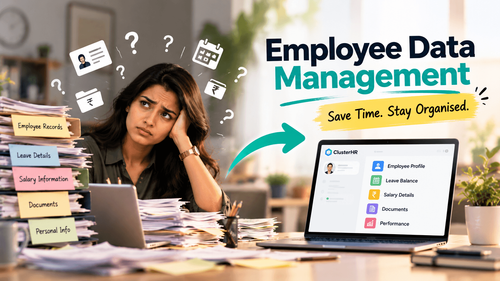
Imagine an HR executive who needs an employee's joining date, leave balance, salary details, and latest performance review. Instead of finding everything in one place, they open multiple Excel sheets, search through email threads, check old documents, and message another team member for confirmation.
What should take a few minutes ends up taking much longer.
Now imagine this happening several times a day across an entire HR team. The time lost may not appear as a separate expense in the company’s accounts, but it affects productivity, delays decisions, and creates unnecessary work.
Employee information is one of the most important resources an HR team manages. Yet, when that information is scattered across spreadsheets, emails, folders, and disconnected tools, finding the right details becomes a daily challenge.
The solution is not simply to work faster. It is to make employee information easier to access, maintain, and use.
Why Does Finding Employee Information Take So Much Time?
In many growing businesses, HR processes develop gradually. A spreadsheet is created for attendance, another for employee details, and a separate file for leave records. Documents are stored in shared folders, while important updates are communicated through email or messaging apps.
Initially, this approach may seem manageable. As the workforce grows, however, the number of records, updates, and requests increases.
Here are some common reasons why HR teams spend too much time searching for employee information.
1. Employee Data Is Scattered Across Different Systems
Employee details rarely exist in just one place when businesses rely on manual processes.
Basic information may be stored in an Excel file, salary details in payroll software, attendance records in another system, and employment documents in individual folders.
Whenever HR needs a complete picture of an employee, someone must collect information from different sources.
This repeated effort wastes time and increases the possibility of missing important details.
2. Multiple Versions of the Same Record Create Confusion
Consider an employee who changes their address, bank details, or emergency contact information. The update may be made in one spreadsheet but missed in another.
Now, HR has to determine which record is correct.
Multiple versions of employee records create uncertainty, especially when different team members maintain separate files. Even a small mismatch can lead to additional verification work or incorrect information being used in a business process.
3. Employees Depend on HR for Routine Information
HR teams frequently receive questions such as:
- How many leave days do I have remaining?
- Where can I find my salary slip?
- Has my personal information been updated?
- Which documents do I need to submit?
- Where can I access company policies?
When employees cannot access routine information themselves, HR has to respond to each request individually.
These questions are important, but answering the same queries repeatedly leaves less time for recruitment, employee development, workforce planning, and other strategic activities.
4. Important Documents Are Difficult to Track
Employee management involves several documents, including offer letters, identity records, employment contracts, policy acknowledgements, and other work-related paperwork.
If these documents are saved using inconsistent file names or stored across different folders, locating the right version becomes difficult.
The problem becomes more serious when a document is needed urgently for an internal review, compliance requirement, or employee query.
A structured document management process helps HR find the information it needs without repeatedly checking different locations.
5. Employee Updates Are Not Communicated Properly
Employee information changes regularly. People get promoted, move to different departments, change reporting managers, or update their contact details.
When these changes are communicated informally, the relevant records may not be updated on time.
HR then spends additional time confirming details with managers, employees, and other departments.
A clear process for recording and updating employee information reduces this unnecessary back-and-forth.
How Much Time Is Your HR Team Actually Losing?
The exact amount depends on the size of the organisation, the number of employee queries, and the systems being used. However, even a small amount of time lost per request can add up quickly.
Consider a simple example.
Suppose an HR team handles 30 employee information requests every working day. If each request takes an average of five minutes to resolve, the team spends 150 minutes daily answering these requests.
That is two and a half hours every working day.
Over 22 working days, this adds up to 55 hours per month.
These figures are illustrative, not an industry benchmark. Your actual numbers may be higher or lower. The important point is that repetitive information searches can consume a significant amount of working time.
To understand the problem in your organisation, track how frequently HR searches for employee records, verifies updates, retrieves documents, and answers routine employee questions.
The results can help you identify where improvements will have the greatest impact.
What Can Businesses Do to Make Employee Information Easier to Find?
Reducing time spent searching for employee data requires a structured approach. Businesses do not necessarily need to redesign every HR process at once. They can start by improving how information is stored, updated, and accessed.
1. Create a Centralised Employee Database
A centralised employee database brings important employee information together in an organised system.
Instead of maintaining several disconnected records, HR can access relevant employee details through a common platform, subject to appropriate permissions.
This makes routine information retrieval easier and reduces the need to switch between multiple files.
A centralised database also gives HR a clearer view of employee records and helps establish consistent information management practices.
2. Standardise How Employee Information Is Updated
Businesses should define how employee information is collected, changed, reviewed, and maintained.
For example, when an employee changes departments, the process should clearly establish who records the change and which related information needs updating.
Standardised processes reduce dependency on informal communication and make it easier to maintain accurate records over time.
3. Give Employees Access to Their Own Information
An employee self-service portal allows employees to access supported information and complete routine HR tasks themselves.
Depending on the system, employees may be able to view payslips, check leave balances, submit requests, and update permitted personal details.
This reduces the need for HR to handle every small request manually. It also gives employees more control over routine interactions with the HR department.
4. Organise Employee Documents Digitally
Employee documents should follow a consistent structure, with clear naming conventions, controlled access, and a defined process for updating records.
Digital document management makes retrieval easier than relying on scattered paper files or unstructured folders.
Businesses should also establish appropriate access controls and retention practices to protect sensitive employee information.
5. Connect HR Processes Where Possible
Employee information is often required across several HR activities.
For example, employee details may be relevant to attendance, payroll, onboarding, performance management, and employee support.
When these processes operate through disconnected systems, HR may have to enter or verify the same information repeatedly.
Connected HR software can reduce this duplication by allowing relevant information to flow between supported modules. The level of integration depends on the platform and its configuration.
Why Core HR Software Makes a Difference
Core HR software provides a structured way to maintain and manage essential employee information.
Instead of relying entirely on separate spreadsheets and manually maintained records, HR teams can use a central system to manage employee profiles, employment details, organisational information, and other supported records.
The benefits extend beyond finding information faster.
Better data consistency: A structured system makes it easier to maintain employee records and track changes.
Less repetitive work: HR teams can spend less time searching through files and verifying the same details repeatedly.
Improved employee experience: Employees can access supported information more easily when self-service capabilities are available.
More informed decisions: Organised employee information helps HR review workforce details and identify relevant trends.
Better process visibility: Clearer records and defined workflows make it easier to understand where information is maintained and how it is updated.
However, software alone cannot solve every data problem. Businesses still need clear processes, accurate initial records, suitable access permissions, and regular reviews to keep information reliable.
Signs Your Business Has Outgrown Manual Employee Data Management
How do you know when it is time to rethink your current approach?
Look for these warning signs:
- HR regularly asks employees to resend information they have already submitted.
- Different departments maintain separate versions of employee records.
- Finding an employee document requires checking several folders or asking multiple people.
- HR executives spend a large part of their day answering routine information requests.
- Employee details are updated in one system but not reflected in related processes.
- Preparing workforce reports requires manually combining multiple spreadsheets.
- Important employee information depends heavily on the knowledge of one HR executive.
If several of these situations sound familiar, the issue may not be the effort your HR team is putting in. It may be the way employee information is organised and managed.
Addressing the underlying process can help HR move away from repetitive administrative work and focus on activities that support employees and business growth.
Conclusion: Stop Searching for Employee Data and Start Managing It Better
Your HR team should not have to spend valuable working hours searching through spreadsheets, emails, and folders to find basic employee information. As a business grows, manual processes become harder to maintain, and disconnected records can create delays, duplication, and avoidable errors.
A centralised approach to employee data management helps businesses make information easier to find, maintain, and use. Combined with clear processes and employee self-service, it can reduce repetitive work and improve the overall HR experience.
ClusterHR helps businesses manage employee information through its Core HR software, bringing essential employee records into a more organised system. Its integrated HRMS also supports connected HR processes, helping businesses reduce dependence on scattered records and manual workflows.
If your HR team spends too much time looking for employee information instead of acting on it, explore ClusterHR Core HR Software to see how a more organised approach to employee management can support your business.