"Why do we need HR software? We are only 30 employees."
It sounds reasonable.
At 20 or 30 employees, HR processes can often be managed through spreadsheets, emails, separate payroll tools, and a lot of manual coordination. Everyone knows each other, employee records are relatively easy to maintain, and HR can usually keep things moving.
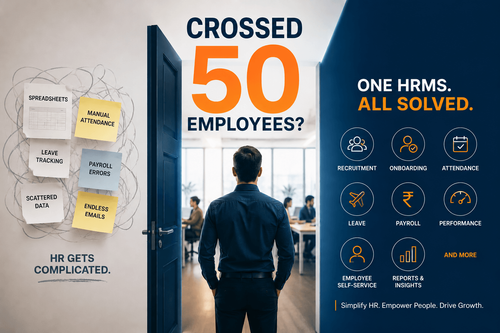
Then the company reaches 50 employees.
Suddenly, the same approach starts feeling different.
There are more people to onboard, more attendance records to track, more leave requests to approve, more payroll data to manage, more employee questions to answer, and more information for managers to access.
The problem isn't that 50 is a magic number.
The real change is operational complexity.
As the workforce grows, HR needs systems that can handle more information, more processes, and more people without multiplying the administrative workload.
This is where an integrated HRMS can make a meaningful difference.
Why HR Becomes More Complicated After 50 Employees
A business doesn't become difficult to manage simply because it reaches a certain headcount.
It becomes difficult when the number of HR transactions starts exceeding what manual processes can comfortably handle.
With a smaller workforce, an HR manager may be able to remember who joined recently, which employee is on leave, whose attendance needs correction, and which documents are pending.
At 50 employees and beyond, that becomes increasingly difficult.
There are more variables and more dependencies.
Recruitment affects onboarding.
Onboarding affects employee records.
Attendance affects leave and payroll.
Managers need access to workforce information.
Employees need access to their own HR information.
This is why businesses eventually need to move from people-dependent HR processes to system-driven HR processes.
1. Hiring Becomes a Continuous Process
When a business is growing, recruitment doesn't stop.
New positions are created, teams expand, and employee turnover creates additional hiring requirements.
Managing candidates through email and spreadsheets becomes increasingly difficult.
HR needs to track:
- Job openings
- Applications
- Candidate information
- Interview schedules
- Interview feedback
- Selection status
- Offers
- Joining dates
A structured recruitment system gives HR a central place to manage this information.
Instead of searching through email threads or spreadsheets, recruiters can track candidates throughout the hiring process.
This becomes particularly valuable when multiple people are involved in recruitment.
2. Onboarding Requires More Structure
Hiring someone is only the beginning.
Once a candidate accepts an offer, HR needs to collect documents, create employee records, assign tasks, communicate joining information, and ensure that the new employee completes the required formalities.
When only a few employees are joining, HR can manage this manually.
As hiring increases, onboarding can become repetitive and inconsistent.
A structured employee onboarding process helps ensure that every new employee follows the same basic workflow.
It also reduces the possibility of missing important steps.
3. Attendance Is No Longer Simple
Attendance management becomes increasingly complicated as teams expand.
Businesses may have different departments, locations, shifts, working schedules, or attendance rules.
Employees may also work from different locations.
HR needs accurate information about working hours, attendance, shifts, overtime, late arrivals, and corrections.
When this information is managed manually, HR spends considerable time checking and updating records.
An attendance management system can centralise these activities and provide managers with better visibility.
More importantly, accurate attendance data can support downstream HR processes such as leave and payroll.
4. Leave Requests Start Adding Up
Five employees requesting leave isn't particularly difficult.
Fifty employees following different schedules and leave balances is another story.
HR needs to keep track of:
- Leave balances
- Leave requests
- Approvals
- Holidays
- Unpaid leave
- Department availability
When employees rely on emails or messages to request leave, tracking can become messy.
A leave management system creates a structured workflow where employees can submit requests and managers can approve them digitally.
HR gets better visibility without having to manually track every request.
5. Payroll Depends on Accurate HR Data
Payroll is one of the areas where disconnected HR processes can create serious administrative work.
Salary calculations may depend on attendance, leave, employee information, deductions, overtime, incentives, and other factors.
If these records exist in different places, HR needs to reconcile them before payroll processing.
An integrated HRMS can connect relevant employee information and reduce the amount of repeated data entry.
This can make payroll processing more organised and help reduce avoidable errors.
6. Employee Questions Increase
As the workforce grows, HR becomes the centre for countless routine questions.
"How many leave days do I have?"
"Can I download my payslip?"
"Has my attendance been updated?"
"Where can I find my employee documents?"
Individually, these questions are simple.
Collectively, they consume a significant amount of HR time.
An employee self-service portal can shift many routine activities directly to employees.
Employees get access to their information, while HR gets fewer repetitive requests.
7. Employee Data Needs One Reliable Source
At a small company, employee information might exist in a few spreadsheets and folders.
As the workforce grows, this approach becomes increasingly difficult to maintain.
Employee information can become scattered across:
- HR spreadsheets
- Payroll software
- Attendance systems
- Document folders
- Recruitment tools
This creates a simple but important problem:
Which system has the latest information?
A centralised HRMS gives businesses one place to manage employee information and related HR processes.
That improves consistency and makes information easier to access.
8. Managers Need Better Workforce Visibility
HR isn't the only department that needs employee information.
Managers also need to know what's happening with their teams.
They may need information about:
- Attendance
- Leave
- Employee performance
- Team structure
- Workforce availability
If managers have to depend on HR for every piece of information, HR becomes a bottleneck.
An HRMS can give authorised managers access to relevant information and workflows, allowing them to handle routine approvals more efficiently.
9. Performance Management Becomes More Important
As companies grow, employee performance can no longer be managed entirely through informal conversations.
Managers need structured ways to establish goals, review performance, provide feedback, and track development.
A performance management system helps bring consistency to this process.
Instead of relying entirely on annual conversations or scattered documents, businesses can create a more organised approach to performance management.
This becomes increasingly important as teams and reporting structures become larger.
10. HR Needs Better Reporting
A growing business generates more HR data.
Leadership may want answers to questions such as:
- How many employees do we have?
- Which departments are growing?
- What is our attendance pattern?
- How many people are being hired?
- How quickly are vacancies being filled?
- What are our workforce costs?
- What is employee performance looking like?
If HR has to manually compile this information every time management asks, reporting becomes another administrative burden.
A centralised HRMS can make HR data easier to access and analyse.
The Bigger Problem: Disconnected HR Tools
Many businesses try to solve individual HR problems by purchasing separate tools.
One platform handles recruitment.
Another handles attendance.
Another manages payroll.
Another stores employee information.
Another handles performance.
Each tool may work perfectly well on its own.
The problem is what happens between them.
HR has to move information from one system to another.
Employees may have multiple logins.
Data can become duplicated.
Reports become harder to compile.
This is where an integrated HRMS becomes particularly useful.
Instead of adding another tool for every HR problem, businesses can connect multiple HR functions within one system.
When Should a Business Invest in an HRMS?
There isn't a universal employee number that determines when a company needs HR software.
A better approach is to look at operational complexity.
You should seriously consider an HRMS when:
- HR spends too much time on repetitive administration.
- Employee information is scattered across different systems.
- Payroll requires manual reconciliation.
- Attendance corrections are frequent.
- Leave tracking is becoming difficult.
- Recruitment is increasing.
- Managers depend heavily on HR for routine tasks.
- Employees frequently ask HR for basic information.
- Management needs better workforce reporting.
If these problems are already happening, waiting for the workforce to become even larger may only increase the administrative burden.
Why an Integrated HRMS Makes Sense for Growing Businesses
The goal of HR technology isn't simply to automate individual tasks.
The bigger opportunity is to connect the entire employee lifecycle.
Recruitment → Onboarding → Employee Management → Attendance → Leave → Payroll → Performance → Employee Self-Service
When these functions work together, HR doesn't have to repeatedly enter the same information or switch between disconnected platforms.
The result is a more structured HR operation that can support growth without creating unnecessary administrative complexity.
How ClusterHR Helps Solve Growing HR Challenges
ClusterHR is designed to bring core HR functions together in one integrated HR Management System.
Businesses can manage recruitment, employee onboarding, attendance, leave, payroll, employee self-service, performance management, workforce management, and other HR operations through a connected platform.
This means businesses don't have to treat every HR challenge as a separate software problem.
As the workforce grows, ClusterHR helps HR teams organise employee information, streamline workflows, reduce repetitive administrative work, and provide employees and managers with easier access to relevant HR processes.
For a business moving beyond 50 employees, that can make the difference between HR processes that simply keep up and an HR operation that is built to support the next stage of growth.
Conclusion
Crossing 50 employees doesn't automatically mean your HR processes will fail.
But it is often the point where businesses begin to see the limitations of systems built for a much smaller workforce.
More employees create more data, more approvals, more recruitment activity, more attendance records, more payroll information, and more employee interactions.
Trying to manage all of that through spreadsheets and disconnected tools can eventually turn HR into an administrative bottleneck.
The answer isn't necessarily to hire more people to manage the same manual processes.
It is to build better processes.
An integrated HRMS gives businesses the infrastructure to manage HR more efficiently as they grow.
And for businesses looking to bring their HR operations together, ClusterHR provides one connected platform designed to simplify the employee lifecycle from hiring to everyday workforce management.