"Payroll day is coming. Have all attendance records been collected?"
If this question creates stress in your office every month, you are not alone.
Many businesses still depend on spreadsheets, manual calculations, emails, and multiple approvals to process salaries. For a small team, this may seem manageable. However, as a business grows, payroll becomes one of the most time-consuming and error-prone processes in the organization.
Now imagine another company of the same size. Their payroll is completed in a fraction of the time. Salary calculations are automated. Attendance data flows directly into payroll. Compliance reports are generated instantly.
The difference is not the size of the company.
The difference is the system they use.
As businesses prepare for 2026, the debate is no longer whether payroll software is useful. The real question is:
Does payroll software actually save more money than manual payroll?
Let's examine the facts.
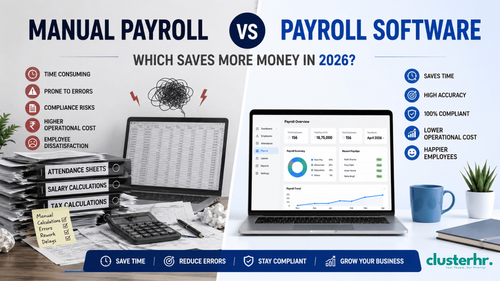
Understanding Manual Payroll
Manual payroll refers to processing employee salaries without dedicated payroll software.
In most cases, businesses rely on:
- Excel spreadsheets
- Attendance registers
- Email approvals
- Manual tax calculations
- Separate leave records
- Individual salary sheets
The HR or accounts team collects employee attendance data, calculates salaries, applies deductions, processes taxes, and generates payslips manually.
At first glance, this approach appears affordable because there is no software subscription cost.
However, the hidden costs often tell a different story.
The Hidden Costs of Manual Payroll
Many business owners calculate only the direct expenses associated with payroll.
What they often overlook are the indirect costs.
Time Spent Every Month
Consider a company with 50 employees.
The payroll process may involve:
- Collecting attendance records
- Reviewing leave balances
- Calculating overtime
- Applying deductions
- Generating salary slips
- Verifying tax deductions
- Resolving employee queries
Even if the process takes just two days every month, that amounts to 24 working days annually.
That is nearly an entire month spent on payroll activities alone.
Human Errors
Manual calculations increase the possibility of mistakes.
Common payroll errors include:
- Incorrect salary calculations
- Wrong tax deductions
- Attendance mismatches
- Duplicate entries
- Missing overtime payments
Even a small error can result in employee dissatisfaction and additional administrative work.
Compliance Risks
Payroll compliance requirements continue to evolve.
Businesses must ensure accurate handling of:
- Provident Fund
- Employee State Insurance
- Professional Tax
- Tax Deducted at Source
- Labour regulations
Missing a compliance requirement can lead to penalties and legal complications.
Employee Trust
Employees expect accurate and timely salary payments.
Repeated payroll errors can reduce confidence in the organization's processes.
While this cost is difficult to measure directly, it affects employee satisfaction and retention.
What Is Payroll Software?
Payroll software is a digital solution that automates salary processing and related payroll tasks.
Instead of relying on spreadsheets and manual calculations, businesses can manage payroll through a centralized platform.
Most payroll systems offer:
- Automated salary calculations
- Attendance integration
- Leave management integration
- Tax calculations
- Payslip generation
- Compliance management
- Payroll reports
The goal is simple.
Reduce manual effort while improving accuracy.
How Payroll Software Saves Money
Many business owners focus on software subscription costs.
A better approach is to compare the total operational cost of payroll management.
Reduced Administrative Time
Automation significantly reduces repetitive tasks.
Payroll software can automatically:
- Calculate salaries
- Apply deductions
- Generate payslips
- Process leave adjustments
- Create payroll reports
This allows HR teams to focus on employee management rather than payroll calculations.
Fewer Payroll Errors
Automation eliminates many common mistakes associated with manual data entry.
Accurate payroll processing means:
- Fewer employee complaints
- Less rework
- Better compliance
- Improved trust
Reducing payroll errors alone can save significant administrative costs over time.
Better Resource Utilization
When HR professionals spend less time processing payroll, they can focus on activities that contribute to business growth.
These include:
- Recruitment
- Employee engagement
- Performance management
- Training initiatives
This shift creates measurable business value.
Improved Compliance
Payroll software often includes built-in compliance support.
This helps businesses remain aligned with changing regulations and reporting requirements.
Avoiding penalties and compliance issues can save substantial costs in the long run.
Manual Payroll vs Payroll Software: Cost Comparison
Let's compare a typical growing business with 100 employees.
Manual Payroll
Estimated monthly effort:
- 15 to 20 hours of payroll work
- Multiple verification steps
- Frequent employee queries
- Compliance tracking
Potential costs:
- HR administration time
- Payroll correction efforts
- Compliance risks
- Reporting challenges
Payroll Software
Estimated monthly effort:
- 2 to 5 hours of payroll oversight
- Automated calculations
- Centralized employee data
- Faster reporting
Potential costs:
- Software subscription
- Initial setup
While payroll software has a direct cost, the reduction in operational expenses often outweighs the investment.
Payroll Software for Startups
Many startup founders assume payroll software is only necessary after significant growth.
This assumption often creates challenges later.
Startups experience rapid changes such as:
- New hires
- Role changes
- Salary revisions
- Leave policies
- Compliance requirements
Managing these activities manually can quickly become overwhelming.
Why Startups Benefit from Payroll Software
Faster Scaling
As employee numbers increase, payroll complexity grows.
Payroll software for startups scale without increasing administrative workload.
Better Accuracy
Startups cannot afford payroll mistakes that impact employee trust.
Automation helps maintain consistency from the beginning.
Professional Employee Experience
Modern employees expect:
- Digital payslips
- Leave tracking
- Self-service access
- Payroll transparency
Payroll software supports these expectations.
Strong Operational Foundation
Implementing payroll software early helps establish structured HR processes that support future growth.
Common Signs You Have Outgrown Manual Payroll
Many businesses continue using manual systems longer than they should.
Here are some warning signs.
Payroll Takes Multiple Days
If payroll processing requires several days each month, efficiency is becoming a problem.
Frequent Payroll Corrections
Repeated adjustments indicate that manual processes are creating unnecessary risk.
Increasing Employee Queries
A growing number of payroll-related questions often signals a lack of transparency and automation.
Compliance Feels Complicated
If compliance management requires significant effort, automation can help simplify the process.
HR Teams Are Overloaded
When HR spends more time managing payroll than people, productivity suffers.
Questions Businesses Commonly Ask
Is Payroll Software Worth the Cost?
For most growing businesses, yes.
The reduction in administrative effort, errors, and compliance risk often provides a positive return on investment.
Can Small Businesses Use Payroll Software?
Absolutely.
Many payroll platforms are designed specifically for small and medium-sized businesses.
Does Payroll Software Reduce Human Involvement?
No.
It reduces repetitive tasks while allowing HR professionals to focus on strategic activities.
How Much Time Can Payroll Software Save?
The exact number varies by company size and process complexity.
However, businesses often report substantial reductions in payroll processing time after automation.
Is Payroll Software Secure?
Modern payroll platforms include security measures designed to protect sensitive employee information.
The Future of Payroll in 2026
Payroll expectations are changing.
Businesses increasingly expect:
- Real-time payroll insights
- Automated compliance
- Employee self-service access
- Mobile accessibility
- Integration with attendance systems
Manual payroll processes struggle to keep pace with these expectations.
Organizations that continue relying entirely on spreadsheets may find themselves spending more time and money maintaining outdated workflows.
Meanwhile, companies adopting payroll automation can focus on productivity, growth, and employee experience.
Final Verdict: Which Saves More Money?
When viewed only from the perspective of software fees, manual payroll may appear cheaper.
However, payroll costs extend beyond software subscriptions.
Businesses must consider:
- Time spent on payroll processing
- Administrative workload
- Payroll errors
- Compliance risks
- Employee experience
- Scalability
When these factors are included, payroll software often proves to be the more cost-effective option.
For growing businesses, the question is no longer whether payroll software costs money.
The better question is:
How much is manual payroll costing your business every month?
Simplify Payroll Management with ClusterHR
Managing payroll manually becomes increasingly difficult as businesses grow. From attendance tracking and leave management to salary processing and compliance, every step demands accuracy and time.
ClusterHR helps businesses simplify these processes through an integrated workforce management platform. With features such as payroll automation, employee attendance management, employee onboarding, performance management, and employee self-service access, businesses can manage their workforce from a single system.
Whether you are a startup building your HR foundation or an established organization looking to improve efficiency, ClusterHR helps reduce manual effort, improve payroll accuracy, and create a better experience for both HR teams and employees.