"Can this payroll software handle our growing team?"
"Will it integrate with attendance?"
"Is it compliant with Indian payroll regulations?"
If you're evaluating a payroll management system, these are the questions you should be asking.
Choosing payroll software isn't just about automating salary calculations. It's about selecting a solution that becomes part of your daily HR operations. The right platform should save time, reduce payroll errors, simplify compliance, and support your business as it grows.
Unfortunately, many businesses purchase payroll software based only on pricing or basic features. A few months later, they discover that the system doesn't integrate with attendance, requires too much manual work, or cannot scale with their workforce.
A payroll management system is a long-term investment. Making the right decision from the beginning can save hundreds of hours of administrative work every year.
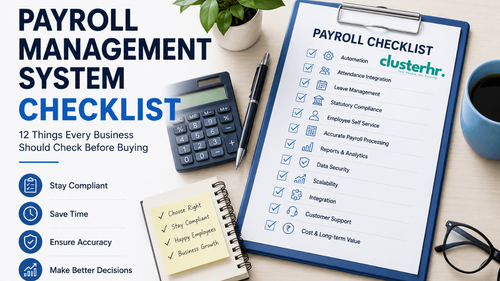
This checklist will help you evaluate every important feature before making your decision.
Why Choosing the Right Payroll Management System Matters
Payroll affects every employee in your organization.
Salary processing, attendance, leave management, tax calculations, reimbursements, and statutory compliance all depend on an efficient payroll process.
A poor payroll system often leads to:
- Payroll errors
- Delayed salary processing
- Employee dissatisfaction
- Compliance issues
- Increased HR workload
A good payroll management system eliminates these challenges and helps HR teams focus on people instead of paperwork.
Checklist 1: Automated Payroll Processing
One of the biggest reasons businesses invest in payroll software is automation.
The system should automatically calculate:
- Gross salary
- Net salary
- Overtime
- Incentives
- Deductions
- Taxes
Automation reduces manual calculations and minimizes payroll errors.
Checklist 2: Attendance Integration
Payroll and attendance should never work separately.
If attendance data has to be entered manually every month, your payroll process will remain slow and error-prone.
Choose software that automatically syncs attendance with payroll calculations.
This improves both speed and accuracy.
Checklist 3: Leave Management Integration
Employee leave directly affects salary processing.
A good payroll management system should automatically calculate:
- Paid leave
- Unpaid leave
- Casual leave
- Sick leave
- Leave balances
This eliminates manual adjustments at the end of every payroll cycle.
Checklist 4: Compliance Support
Payroll regulations continue to evolve.
Your payroll software should support compliance requirements related to:
- Provident Fund
- Employee State Insurance
- Professional Tax
- Tax Deducted at Source
- Labour regulations
Managing compliance manually increases business risk.
Checklist 5: Employee Self Service Portal
Employees frequently ask HR questions such as:
- Can I download my payslip?
- How many leave days are available?
- Is my attendance updated?
An Employee Self Service Portal allows employees to access this information independently.
This reduces HR workload and improves employee experience.
Checklist 6: Easy Report Generation
Business leaders require payroll insights.
Your software should generate reports such as:
- Payroll summaries
- Salary reports
- Attendance reports
- Leave reports
- Department-wise payroll
Access to accurate reports improves decision-making.
Checklist 7: Scalability
Many businesses buy software based on their current employee count.
Instead, think about where your business will be in three years.
A scalable payroll management system should support:
- New employees
- Multiple branches
- Additional departments
- Business expansion
Replacing payroll software later can be expensive and time-consuming.
Checklist 8: User-Friendly Interface
HR teams use payroll software every month.
A complicated system reduces productivity.
Look for software with:
- Simple navigation
- Clean dashboards
- Easy report access
- Quick payroll processing
Good software should reduce training time for HR teams.
Checklist 9: Data Security
Payroll contains confidential employee information.
The software should provide:
- Secure login
- Role-based access
- Data backup
- Information protection
Security should never be treated as an optional feature.
Checklist 10: Integration with Other HR Functions
Payroll is only one part of HR management.
The best payroll systems integrate with:
- Recruitment
- Employee onboarding
- Attendance
- Leave management
- Performance management
- Employee records
This creates one connected HR ecosystem instead of multiple disconnected systems.
Checklist 11: Reliable Customer Support
Even the best software requires support occasionally.
Before choosing a payroll management system, evaluate:
- Customer support availability
- Implementation assistance
- Product training
- Issue resolution time
Responsive support saves valuable business time.
Checklist 12: Long-Term Business Value
The cheapest software isn't always the most cost effective.
Instead of asking:
"What is the monthly subscription?"
Ask:
"How much time will this software save every month?"
"Will it reduce payroll mistakes?"
"Can it support our business five years from now?"
A payroll management system should be viewed as an investment rather than an expense.
Common Mistakes Businesses Make While Choosing Payroll Software
Many organizations repeat the same mistakes.
Choosing Based Only on Price
Low-cost software often lacks important business features.
Ignoring Integration
Disconnected HR tools create duplicate work.
Overlooking Employee Experience
Employees value transparency, digital payslips, and self-service access.
Thinking Only About Today's Needs
Businesses grow.
Choose software that grows with you.
Skipping Product Demonstrations
Always request a live product demonstration before making a purchase.
This helps businesses evaluate usability and workflow.
Questions Every Business Should Ask Before Buying
Before selecting a payroll management system, ask these questions.
- Can the software automate payroll completely?
- Does it integrate with attendance and leave management?
- Is payroll processing accurate?
- Can employees access their own payroll information?
- Will it support business growth?
- Is customer support reliable?
- Can reports be generated instantly?
- Does it simplify compliance management?
If the answer to any of these questions is no, continue evaluating other options.
Why Businesses Prefer an Integrated HR Platform
Payroll works best when connected with other HR functions.
Managing recruitment, onboarding, attendance, payroll, leave, and employee records through one platform reduces manual work and improves operational efficiency.
An integrated HR platform also provides better visibility into the complete employee lifecycle.
Instead of switching between multiple systems, HR teams manage everything from one dashboard.
Conclusion
Choosing the right Payroll Management System is not just about processing salaries.
It is about improving business efficiency, reducing payroll errors, simplifying compliance, and creating a better employee experience.
Before making a decision, evaluate every solution using this checklist.
A payroll system should save time, improve accuracy, integrate with your HR processes, and support your business as it grows.
Simplify Payroll and HR Operations with ClusterHR
ClusterHR is designed to help businesses manage payroll and workforce operations through one integrated HR Management System.
Along with Payroll Management, ClusterHR offers Attendance Management, Employee Onboarding, Leave Management, Recruitment Management, Employee Self Service, Performance Management, and Workforce Management from a single platform.
Instead of using multiple disconnected tools, businesses can simplify HR operations, improve productivity, and create a seamless employee experience with ClusterHR.