"Let's wait another six months."
"Our current system is working fine."
"We'll think about HR software once we have more employees."
If you've heard these conversations in your business, you're not alone.
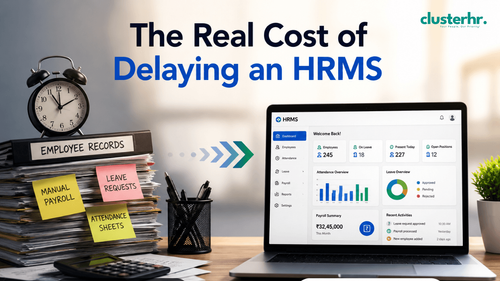
Many companies delay investing in an HR Management System because they believe it is something only large organizations need. At first, manual processes seem manageable. Attendance is tracked in spreadsheets, payroll is handled through separate software, leave requests arrive over email, and employee records are stored in folders.
For a while, everything appears to work.
Then the business grows.
More employees join. More leave requests come in. Payroll takes longer. Recruitment speeds up. HR starts spending more time updating spreadsheets than supporting employees.
This is when businesses realize the real problem.
The biggest expense was never buying an HRMS.
The biggest expense was waiting too long.
Why Businesses Delay Investing in an HRMS
Every growing company has priorities.
Sales need attention.
Marketing requires investment.
Operations continue expanding.
HR often gets pushed to the bottom of the list.
Business owners usually believe they can continue managing HR manually for a little longer.
Some common reasons include:
- "Our team is still small."
- "Excel works fine."
- "We'll automate next year."
- "HR software is expensive."
- "We don't need all those features."
While these reasons may seem reasonable, they often ignore the hidden operational costs that increase every month.
The Hidden Cost of Manual HR
The cost of manual HR isn't always visible on a balance sheet.
It appears in lost time, reduced productivity, payroll corrections, employee frustration, and missed opportunities.
Hours Lost Every Week
Think about how much time your HR team spends on repetitive tasks.
- Updating attendance
- Calculating leave balances
- Processing payroll
- Responding to employee queries
- Preparing reports
- Managing employee documents
Even if each task takes only a few minutes, together they consume several hours every week.
Over a year, that becomes hundreds of hours that could have been spent on recruitment, employee engagement, or business improvement.
Payroll Becomes More Complicated
Payroll is one of the first areas affected by business growth.
As employee numbers increase, payroll calculations become more detailed.
Attendance, overtime, incentives, reimbursements, tax deductions, and compliance all need to be handled accurately.
Without an integrated HR system, HR teams spend more time verifying information than processing salaries.
Every payroll correction creates additional work.
Every delay affects employee confidence.
Recruitment Starts Slowing Down
Growing businesses need talent quickly.
However, manual recruitment creates delays.
Candidate resumes remain scattered across emails.
Interview schedules become difficult to manage.
Feedback takes longer to collect.
Good candidates often accept offers from competitors before your hiring process is complete.
The longer recruitment takes, the more opportunities your business loses.
Attendance Management Becomes Difficult
Attendance may seem like a simple process until the workforce grows.
Suddenly, businesses need to manage:
- Multiple shifts
- Hybrid employees
- Remote teams
- Leave approvals
- Attendance corrections
Manual tracking creates confusion and affects payroll accuracy.
Managers also struggle to understand workforce availability.
Employee Experience Begins to Suffer
Employees expect a modern workplace.
They want quick access to:
- Payslips
- Leave balances
- Attendance records
- Employee information
When every request requires contacting HR, employees become dependent on manual processes.
This increases HR workload while reducing employee satisfaction.
HR Teams Become Administrators Instead of Strategic Partners
HR professionals should focus on people.
They should be improving employee engagement, strengthening company culture, supporting managers, and developing talent.
Instead, many HR teams spend most of their day updating spreadsheets.
This prevents HR from contributing to long-term business growth.
The Cost of Waiting Grows Every Time You Hire
Every new employee increases administrative work.
Without automation, every additional hire creates:
- More attendance records
- More payroll calculations
- More employee documents
- More leave requests
- More HR queries
The business continues growing.
Unfortunately, manual HR grows with it.
Eventually, the process becomes difficult to manage.
Signs Your Business Has Waited Too Long
You may already need an HRMS if:
- Payroll takes more than a day every month.
- HR maintains multiple spreadsheets.
- Employees frequently ask for attendance updates.
- Recruitment feels disorganized.
- Managers struggle to track employee information.
- HR spends more time on administration than people.
- Reports take hours to prepare.
- Business growth feels harder to manage.
If several of these situations sound familiar, waiting longer is unlikely to solve the problem.
What an HRMS Actually Solves
Many business owners think HR software simply automates payroll.
Modern HR Management Systems do much more.
They create one connected platform for the entire employee lifecycle.
This includes:
Recruitment Management
Track candidates, schedule interviews, and manage hiring from one dashboard.
Employee Onboarding
Create a structured onboarding experience for every new employee.
Attendance Management
Track attendance accurately without manual updates.
Leave Management
Employees can submit leave requests while managers approve them digitally.
Payroll Management
Process salaries with greater speed and accuracy.
Employee Self Service
Employees access payslips, attendance, and leave information without contacting HR.
Performance Management
Support employee growth through structured reviews and goal tracking.
Everything works together.
Instead of maintaining separate systems, businesses manage HR from one platform.
Why Businesses That Invest Early Grow Faster
Companies that implement an HRMS early often experience smoother growth.
This is because they build structured HR processes before complexity increases.
Instead of solving problems later, they prevent them from happening.
Benefits include:
- Faster HR operations
- Better workforce visibility
- Improved employee experience
- More accurate payroll
- Better recruitment
- Higher productivity
Most importantly, HR teams gain time to support business growth instead of managing paperwork.
Questions Business Owners Should Ask
Before deciding to postpone HR automation, consider these questions.
- How many hours does HR spend on manual work every week?
- How often are payroll corrections required?
- How many spreadsheets does HR maintain?
- How long does recruitment take?
- Are employees waiting for HR to answer simple questions?
- Can the current system support twice as many employees?
These questions often reveal that the cost of waiting is much higher than expected.
Why an Integrated HRMS Makes More Sense
Some businesses purchase separate tools for:
- Payroll
- Attendance
- Recruitment
- Leave management
While this appears flexible, it creates disconnected workflows.
Employee data has to be entered multiple times.
Information becomes inconsistent.
Reporting becomes difficult.
An integrated HRMS keeps every HR activity connected.
This improves efficiency while reducing duplicate work.
Conclusion
Delaying an HRMS often feels like a way to save money.
In reality, the hidden costs continue growing every month.
Manual payroll, scattered employee records, attendance errors, recruitment delays, and repetitive administrative work all reduce productivity and make growth more difficult.
An HRMS is not just another software investment.
It is a business tool that helps organizations simplify operations, improve employee experience, and build a stronger foundation for future growth.
The earlier businesses adopt structured HR processes, the easier it becomes to manage expansion with confidence.
Simplify Every Stage of HR with ClusterHR
ClusterHR is an all-in-one HR Management System built for growing businesses.
From recruitment and employee onboarding to attendance management, payroll processing, leave management, employee self-service, performance management, and workforce management, ClusterHR brings every HR function together on one platform.
Instead of managing multiple tools and manual processes, businesses can streamline their HR operations, improve efficiency, and give employees a better workplace experience.
As your business grows, ClusterHR grows with you, helping your HR team spend less time on administration and more time building a stronger workforce.